Hierarchical attention-based framework for enhanced prediction and optimization of organic and inorganic material synthesis
- Abstract
- Additional Comments
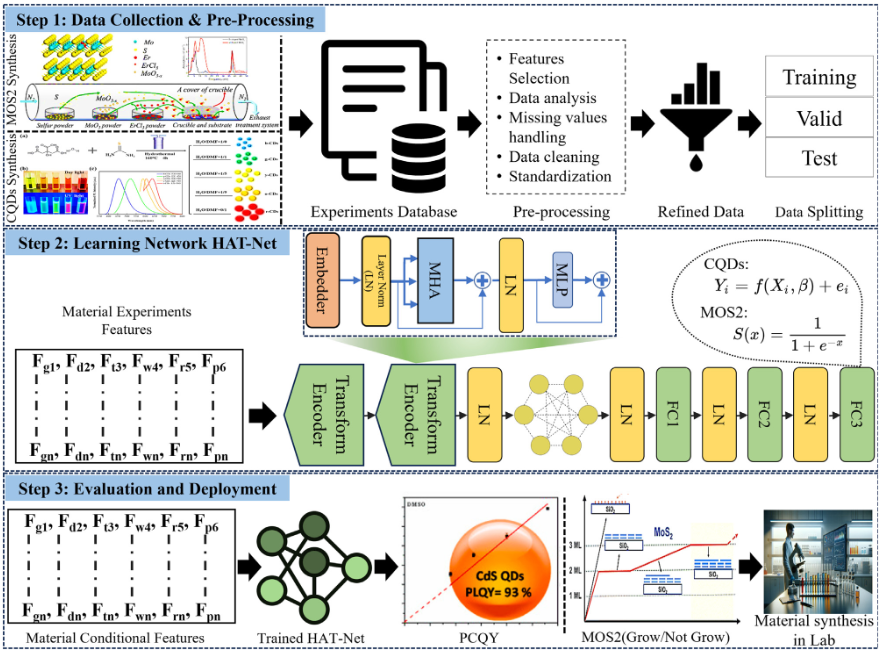
Optimizing the synthesis of organic and inorganic materials, including molybdenum disulfide (MoS2), and estimating the photoluminescent quantum yield (PLQY) remains a complex and time-intensive challenge with significant applications in high-impact areas such as energy storage, light-emitting devices, and light-filtering materials. Traditional machine learning approaches like XGBoost and support vector machines (SVMs) have shown effectiveness in predicting material properties; however, they often require manual feature engineering and are limited in capturing intricate dependencies across experimental parameters. To address these limitations, this study proposes a unified hierarchical attention transformer network (HATNet) that leverages the multi-head-attention (MHA) mechanism to automatically learn complex interactions within feature spaces, providing a more flexible and powerful alternative for synthesis optimization. Our proposed framework is applied to two key tasks: MoS2 growth status classification and carbon quantum dot (CQD) PLQY estimation. This framework captures high-order feature dependencies in small and large datasets for regression and classification through a shared attention-based encoder. The experimental results demonstrate that HATNet outperforms state-of-the-art methods, achieving higher predictive performance, with a 95% classification accuracy for MoS2 synthesis and a mean squared error (MSE) of 0.003 on inorganic compositions and 0.0219 on organic compositions for carbon quantum yield estimation. These results illustrate HATNet’s adaptability and accuracy in synthesizing advanced materials, highlighting its versatility as a tool for guiding experimental synthesis across various materials in the field of materials science.